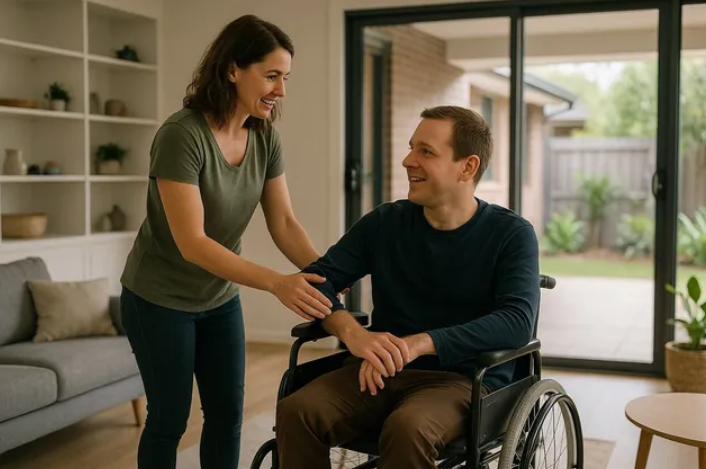
SDA is often misdescribed.
People talk about care. Support hours. Staffing models. Who lives with whom? Those conversations belong elsewhere. In other funding streams. Different discussions.
When it comes to SDA Housing in Adelaide, the real story is design. Physical space. Layout choices. Technology is baked into buildings. Features you notice immediately, or sometimes not at all, until you realise how much easier things feel.
That difference matters.
SDA Is About the Building, Not the Living Arrangement
This is where confusion usually starts.
SDA does not provide daily support. It does not dictate whether living is shared or private. It does not organise routines.
SDA Housing in Adelaide exists to provide a physical environment that meets particular accessibility, safety, and functional needs. Think structural capability. Wide circulation spaces. Ceiling strength. Smart home readiness. Noise reduction. Line of sight.
Support may happen in the home. But it does not come from the house.
Once that clicks, the rest makes more sense.
Adelaide Has Space to Get Design Right
One quiet advantage Adelaide has is room.
Compared to denser cities, there is more flexibility with land size, setbacks, and planning models. That allows SDA Housing in Adelaide to focus on functionality rather than compromise.
Homes can be built with proper turning circles. Bedrooms can accommodate equipment without feeling clinical. Bathrooms can support assisted use while still feeling private.
Design breathes a little here. And that breathing space shows up in daily experience.
Design Categories Are Not Just Labels
Improved Liveability. Robust. Fully Accessible. High Physical Support.
On paper, those categories feel technical. In real life, they change how a space behaves.
In SDA Housing in Adelaide, differences between categories often manifest in subtle ways. Wall construction that absorbs sound. Power systems that support backup. Bathroom layouts that allow assistance without crowding. Entry points that reduce transfer risk.
It is not about one feature. It is about how all the features work together.
Good Design Reduces Dependence Without Saying a Word
This part often goes unnoticed until someone experiences it.
When doors open smoothly. When lighting adjusts easily. When controls are reachable from multiple positions. When space allows movement without constant recalculation.
Suddenly, fewer workarounds are needed.
That is one of the quiet strengths of well-executed SDA Housing in Adelaide. It does not announce its purpose. It simply removes friction. When friction disappears, independence naturally increases.
Not dramatically. Just consistently.
See also: Breathe Easier – The Health Benefits of Condo Duct Cleaning
Location Is Part of the Design Conversation
Design does not stop at the front door.
Being close to transport, health services, community spaces, and familiar neighbourhoods shapes how people engage with their environment.
Much of SDA Housing in Adelaide is deliberately placed near established infrastructure. Not isolated. Not hidden. Integrated.
That integration supports routine. Predictability. Choice.
And choice matters.
Families Often Notice the Difference Before Participants Do
An interesting pattern reappears.
Families walk into a thoughtfully designed SDA home and exhale. They notice the circulation space. Sightlines. Safety details they have spent years worrying about.
Participants often just feel calmer. More settled. Less restricted.
That is the outcome SDA Housing in Adelaide aims for. Not an obvious “accessible” feel, but a sense that the space works without effort.
New Builds Are Learning From Old Mistakes
Earlier disability housing models prioritised durability but missed comfort. Or accessibility, but lost privacy.
Newer SDA Housing in Adelaide builds reflect lessons learned the hard way. Materials are warmer. Layouts are more residential. Technology is integrated rather than added on later.
Homes feel like homes first. Accessible environments second. That shift changes how people relate to their homes.
Demand Keeps Growing, Quietly but Consistently
There is no sudden spike. No loud shortage headlines. Just steady pressure.
As awareness improves, more participants explore eligibility. More families understand what SDA actually offers. More planners recognise the design gap it fills.
This ongoing demand shapes SDA Housing in Adelaide’s development decisions. It rewards quality. Penalises shortcuts. Encourages long-term thinking rather than fast builds.
Comparison Is Hard Without the Right Questions
Families and participants often struggle to compare options.
All homes look accessible in brochures.
The difference shows up when asking better questions. How does the home support future needs? What technology is embedded, not optional. How adaptable is the space over time?
Meaningful SDA Housing in Adelaide comparisons focus on longevity, not surface finishes.
The Home Becomes a Platform, Not a Limitation
This might be the simplest way to frame it.
Good SDA housing does not solve everything. But it removes barriers that stop everything else from working.
Therapies. Supports. Daily routines. Social connection. They all sit more comfortably on top of a well-designed base.
That is what SDA Housing in Adelaide does when it is done right. It becomes a platform.
Stable. Predictable. Unobtrusive.
Why This Distinction Matters Moving Forward
As SDA continues to mature, expectations rise.
Participants want homes that feel normal. Families want reassurance. Planners want clarity. Providers are held to higher standards.
Keeping the focus where it belongs is essential.
SDA Housing in Adelaide from Aeon Disability Services is not about care models. It is not about service delivery. It is about physical environments designed to support autonomy safely.
Once that boundary stays clear, decisions improve. Outcomes improve. And people live in spaces that quietly support their lives rather than complicate them.
No fanfare. No excess explanation.
Just design is doing its job.