Table Of Contents
• Why Spill and Waste Planning Matters
• Common Industrial Spill and Waste Risks
• How to Assess a Facility
• What a Useful Spill Plan Should Include
• Better Waste Handling From Start to Finish
• Training Workers for Real-World Conditions
• Equipment and Supplies to Keep Ready
• What to Do During a Spill
• Steps to Take After an Incident
• A Simple Readiness Checklist
• Conclusion
Industrial spill readiness is built long before a container leaks, a transfer line fails, or wastewater reaches a drain. Facilities that identify hazards, organize response supplies, and train people for realistic conditions can make faster, safer decisions when something goes wrong. PROS Services can support industrial facilities that need experienced help with environmental and cleaning challenges.
A useful plan addresses more than a worst-case release. It should help workers manage routine drips, damaged drums, overflowing containers, and larger incidents without losing sight of worker safety, environmental protection, and business continuity. The goal is to protect people first, then limit impacts to equipment, drainage systems, soil, water, and surrounding areas.
Why Spill and Waste Planning Matters
Weak preparation can expose workers to hazards, delay shutdown decisions, complicate cleanup, and create avoidable downtime. Planning should treat small leaks as seriously as major releases, because minor incidents can reach drains or become larger events if ignored. In a 2026 case involving a sulfuric acid spill in Houston, OSHA reported that workers were exposed to hazardous chemical waste without training or proper respirator fit during cleanup. The lesson is clear: cleanup work requires defined roles, protective measures, and limits on who may respond.
Common Industrial Spill and Waste Risks
Every site has a different process, but many industrial facilities face familiar risk points. Used oil, coolant, solvents, degreasers, wastewater, sludge, oily water, and contaminated absorbents all need controlled handling. Drums, tanks, totes, transfer hoses, valves, and pumps can fail through corrosion, impact damage, wear, or improper use.
Pay particular attention to loading docks, maintenance bays, parts-washing stations, outdoor storage areas, and waste accumulation points. Floor drains, storm drains, sloped pavement, ditches, and nearby waterways can carry material away from the original release area. A spill plan should identify these pathways before an emergency occurs.
How to Assess a Facility
A walk-through assessment helps leaders see problems that may not appear in written procedures. Repeat the review after process changes, construction, major equipment repairs, or changes in materials handled onsite.
1. Inspect production, storage, loading, maintenance, and waste-handling areas.
2. Mark drains, slopes, waterways, chemical locations, access routes, and emergency shutoff points.
3. Check tank age, container condition, transfer equipment, pallets, and secondary containment.
4. Confirm that spill kits are visible, complete, and compatible with likely materials.
5. Ask employees where leaks, near misses, or procedural delays have occurred.
6. Record photos, dates, assigned owners, correction deadlines, and closure status.
What a Useful Spill Plan Should Include
A plan should be short enough to use under pressure and detailed enough to guide safe action. Keep a simplified response card at likely spill locations, while maintaining a fuller plan that covers responsibilities and follow-up.
• Alarm procedures and current emergency contacts.
• Roles for supervisors, operators, maintenance personnel, and environmental staff.
• Material information from labels, process records, and safety data sheets.
• Evacuation, isolation, restricted-entry, air-monitoring, and decontamination procedures.
• Steps for drain protection, containment, waste labeling, temporary storage, and disposal.
• Contact procedures for emergency responders and qualified cleanup contractors.
Better Waste Handling From Start to Finish
Effective waste management begins where waste is generated, not when a container is already full. Identify each stream, separate incompatible materials, and use containers suited to the material. Keep lids closed except during use, inspect containers and pallets for corrosion or leaks, and use labels that clearly identify contents and hazards.
Mixing waste streams can create unnecessary uncertainty, increase disposal complexity, and, in some circumstances, create a chemical reaction. Maintain records for inspections, pickups, manifests, and disposal documentation. Consistent documentation also makes it easier to trace recurring issues back to a process, material, or work area.
Training Workers for Real-World Conditions
A policy on a shared drive is not the same as a procedure workers can carry out during a stressful event. Train new employees and refresh training at appropriate intervals. Use short drills that cover leaking containers, blocked drains, transfer failures, reporting steps, and the decision to stop work and leave the area.
Workers should know the limits of small-spill response and understand that they should not attempt containment if doing so increases their risk. Practice radio calls and internal notifications, review near misses without assigning blame, and track attendance, drill performance, test results, and corrective actions.
Equipment and Supplies to Keep Ready
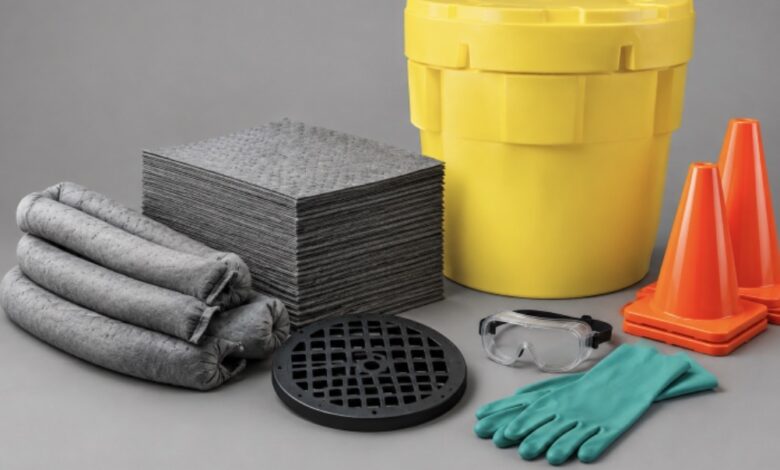
Monthly inspections should verify that response equipment is stocked, accessible, and appropriate for the materials present. Common items include absorbent pads, socks, pillows, granular absorbents, drain covers, berms, plugs, compatible overpack containers, warning signs, cones, labels, and emergency lighting.
Facilities may also need gloves, goggles, face shields, coveralls, boots, respiratory protection when required, non-sparking tools, compatible transfer equipment, portable pumps, and printed safety data sheets. Store supplies near likely spill locations, protect them from damage, and replace used or expired items promptly.
What to Do During a Spill
Use a Simple Response Sequence
1. Protect people by moving workers away from immediate danger.
2. Stop the source only when it can be done without added risk.
3. Isolate the area and control entry.
4. Identify the material using labels, process information, or safety data sheets.
5. Protect drains, soil, and waterways with appropriate containment methods.
6. Notify supervisors, responders, and agencies when required.
7. Use trained personnel and suitable equipment for recovery and cleanup.
8. Document times, actions, quantities, weather, and affected areas.
Response often continues after the immediate danger is controlled. Following a May 26, 2026, industrial incident in Longview, Washington, containment, environmental monitoring, decontamination, and interagency coordination continued beyond the emergency phase. Facilities should plan for that longer recovery period.
Steps to Take After an Incident
Cleanup is only one part of recovery. Confirm that the area is safe before restarting work, collect contaminated materials for proper classification, and inspect floors, drains, equipment, soil, and adjacent surfaces. Preserve photos and records, complete required reports, and speak with involved employees while details remain clear.
Then examine the root cause. A damaged drum may reflect a storage problem, a handling problem, a maintenance gap, or an unclear procedure. Update training, equipment, inspection routines, and maintenance schedules, then check whether the same weakness exists elsewhere in the facility.
A Simple Readiness Checklist
• Are spill kits stocked, visible, and easy to reach?
• Are emergency contacts and response roles up to date?
• Are waste containers closed, labeled, and in good condition?
• Are secondary containment areas clean and usable?
• Have employees completed the required training and practiced a drill?
• Are drains, dikes, pumps, and shutoff points clearly marked?
• Are inspection, pickup, and disposal records complete?
• Have prior corrective actions been verified as closed?
• Can responders access the facility at night, on weekends, and during severe weather?
Conclusion
Spill readiness depends on daily discipline: organized waste handling, clear procedures, trained workers, maintained equipment, and reliable follow-up. Facilities that assess risks before an incident are in a stronger position to protect people, reduce environmental harm, limit disruption, and recover with fewer surprises.