The modern residential overhead garage door functions through an intricate counterbalance network designed to offset substantial deadweight via controlled mechanical advantage. Operating as a dynamic structural barrier, a standard multi-panel sectional door can weigh anywhere from one hundred and twenty to over three hundred and fifty pounds, depending on steel gauge thickness, internal insulation core density, and decorative glass or timber hardware. Because an electric opener motor is engineered strictly to direct travel velocity rather than lift raw, unassisted weight, the structural integrity of the entire mechanism relies completely on the mechanical energy stored within its counterbalance springs. When material fatigue, oxidation, or torsional stress fractures a spring coil, the system experiences an immediate loss of equilibrium, leaving the door completely inoperable and posing severe safety hazards to nearby personnel and property.
Restoring an overhead system after a counterbalance failure requires a deep understanding of rotational torque calibration, wire gauge physics, and dynamic cable tracking. Property owners confronted with a sudden spring snap often begin searching for qualified garage door spring repair near me to obtain professional diagnostic evaluations, spring conversions, and high-tension recalibration. Analyzing the maintenance engineering of these counterbalance assemblies requires a thorough examination of spring metallurgy and Hooke’s Law, the differences between torsion and extension geometries, dynamic cable-drum mechanics, the extreme physical dangers of high-tension hardware, and standardized preventive cycle diagnostics.
Counterbalance Physics, Hooke’s Law, and Elastic Potential Energy
The operational principle of a garage door counterbalance system is grounded in classical mechanics and Hooke’s Law of elasticity. Hooke’s Law establishes that the force required to extend or twist an elastic material is directly proportional to the distance of extension or angle of rotation, provided the material remains within its elastic limit. In an overhead garage door, the counterbalance springs convert physical work into stored elastic potential energy during door closure and release that energy as mechanical lift during door opening.
In a closed position, the garage door panels rest flat against the vertical door opening. In this configuration, the counterbalance springs are fully wound or stretched to their maximum operational limit, holding substantial mechanical potential energy. As the door begins its upward travel, the springs begin uncoiling or contracting, transferring stored energy through mechanical shafts, drums, and cables. This released torque counteracts the downward gravitational pull acting on the door panels. When properly calibrated, the lifting force delivered by the springs perfectly mirrors the door panel weight through every inch of the horizontal and vertical track radius. This achieves neutral mechanical equilibrium, allowing an average homeowner to lift a three-hundred-pound door effortlessly using only one hand when the electric opener is disengaged.
If the springs are incorrectly sized—even by a fraction of a wire gauge—the mathematical balance is broken. Under-tensioned springs fail to offset the weight of the panels, causing the electric opener motor to draw excessive electrical current, overheat its internal windings, and strip plastic gear drives. Conversely, over-tensioned springs exert excessive upward force, pulling the door upward off the floor when closed, jerking the panels violently at the travel limits, and causing slack in the lift cables that leads to severe drum derailment.
Torsion Spring Architecture versus Extension Assemblies
Overhead counterbalance mechanisms are divided into two fundamental configurations: torsion spring assemblies and extension spring assemblies. Each system utilizes distinct mechanical geometries, mounting locations, and kinetic movement patterns to manage door weight.
Torsion spring systems represent the modern standard in residential and commercial overhead door engineering. Mounted directly to the structural header wall above the door opening on a solid or tubular steel torsion shaft, these helical springs operate through angular deflection. A stationary center bearing plate anchors one end of each spring firmly to the wall, while the opposite end secures to an adjustable winding cone locked to the rotating torsion shaft. As the door closes, the shaft rotates, winding the helical coils tighter around the stationary shaft. Because torsion springs undergo rotational twisting rather than linear stretching, they maintain a stable center of gravity, deliver smooth operational motion, and keep the springs contained along the steel shaft in the event of a structural fracture.
Extension spring assemblies, frequently found in older homes or installations with limited overhead clearance, operate via linear elongation. Positioned horizontally above the horizontal ceiling tracks on both sides of the door, extension springs stretch backward toward the rear of the garage as the door descends. The tension is transferred to the bottom door panels through a system of pulleys and stationary cables. Because extension springs expand and contract linearly, they experience uneven lateral stress and cyclic metal stretching. If an extension spring breaks while under full tension without an internal containment cable running through its core, the severed coil can propel through the garage like a high-velocity projectile, shattering windows, penetrating vehicles, or inflicting catastrophic bodily injury.
Material Fatigue Mechanics and Spring Lifecycle Calculations
Garage door springs are manufactured from high-tensile carbon steel, often oil-tempered or galvanized to provide structural ductility and corrosion resistance. Despite their robust construction, all counterbalance springs operate under a finite mechanical fatigue lifespan dictated by cyclic stress. A single operational cycle is defined as one complete opening and one complete closing sequence of the door.
Standard builder-grade torsion springs are typically engineered for an industry baseline of ten thousand operational cycles. In an active household where the garage door is utilized four to six times daily—acting as the primary vehicular and pedestrian entryway—a ten-thousand-cycle spring reaches its metal fatigue limit within four to six years. Advanced residential applications often utilize high-cycle springs calibrated for twenty-five thousand to fifty thousand cycles, incorporating thicker wire diameters, larger inner coil circumferences, and specialized surface shot-peening treatments to relieve microscopic surface tensions.
Metal fatigue within a spring coil occurs at the atomic level. Every time the door opens and closes, the crystalline structure of the steel experiences microscopic dislocations and shear stress. Over thousands of cycles, these micro-fissures coalesce into macroscopic stress cracks, typically originating along the inner diameter of the coil where bending tension is highest. Eventually, the remaining cross-sectional area of the steel wire can no longer withstand the high internal torque, resulting in sudden mechanical fracture accompanied by a loud acoustic bang resembling a gunshot. Because both springs on a dual-spring setup experience identical cycle counts and atmospheric conditions, the failure of one spring indicates that the companion spring is near the end of its fatigue life, requiring simultaneous replacement to preserve operational balance.
Cable Drum Synchronization and Kinetic Equilibrium
The mechanical interface connecting the overhead torsion shaft to the physical door assembly consists of cast aluminum cable drums and multi-strand aircraft cables. The cable drums are keyed and locked to the outer ends of the torsion shaft, while the high-tensile steel cables run down both sides of the door, anchoring securely to heavy-duty bottom corner brackets on the lowest door panel.
Cable drums are engineered with precise spiral grooves that guide the aircraft cable as it wraps and unwraps. In standard-lift residential setups, the drum radius remains constant, ensuring uniform cable take-up speed. In high-lift or vertical-lift configurations, drums feature a tapered conical profile that varies the mechanical advantage across the travel stroke, compensating for changes in effective door weight as panels transition from the vertical wall track into the horizontal overhead track.
Proper cable synchronization is vital for kinetic balance. Both lift cables must maintain identical tension across their entire length. If one cable develops fractional slack due to improper drum set-screw tightening or localized cable stretching, the door will pull unevenly. During travel, the side with tighter tension pulls ahead, canting the door panels into an acute diagonal angle. This uneven orientation forces the roller stems into extreme lateral friction against the track channels, binding the panels tightly between the steel jambs, bending track extrusions, and risking sudden cable unspooling that drops the door onto the floor.
High-Tension Safety Hazards and Professional Servicing Protocols
Servicing a garage door counterbalance assembly is widely recognized as one of the most mechanically hazardous tasks in residential building maintenance. The energy contained within a fully wound torsion spring or fully stretched extension spring is sufficient to cause crushing injuries, severe lacerations, or death if released uncontrollably.
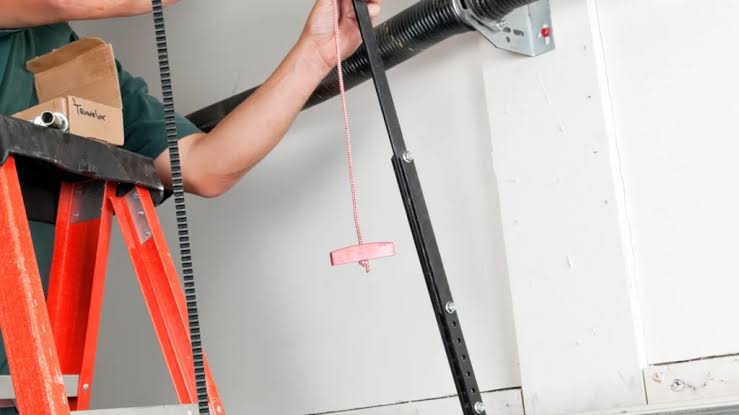
The primary hazard zones include the spring winding cones, the center bearing support bracket, and the bottom corner cable brackets. The bottom brackets on the lowest door panel remain under constant, high-tension cable pulling force, even when the door is partially open. Homeowners attempting to remove or adjust bottom bracket bolts using basic hand tools frequently suffer violent hardware expulsion as the bracket is yanked upward by the spring cable. Similarly, adjusting or replacing torsion springs requires using heavy, cold-rolled solid steel winding bars precision-machined to fit the winding cone sockets. Attempting to wind or unwind a spring using makeshift tools—such as screwdrivers, punch pins, or pipe wrenches—frequently results in the tool slipping under torque, violently throwing the winding bar across the room.
Professional technicians follow strict isolation and containment protocols when servicing counterbalance assemblies. The door panels are securely locked to the track using specialized locking pliers, and the electric opener is mechanically disconnected to prevent accidental automated activation. Technicians systematically relieve existing tension using paired winding bars, verifying that the torsion shaft spins freely without runout before removing damaged coils. New springs are selected based on precise mathematical measurements of wire gauge, inside coil diameter, overall length, and wind direction—left-hand wind versus right-hand wind—ensuring the new components match the exact deadweight specifications of the door.
See also: Protect Your Home with Professional Security Installation
Tribological Maintenance, Environmental Corrosion, and Diagnostic Verification
While counterbalance springs inevitably succumb to metal fatigue over time, their functional lifespan can be compromised prematurely by environmental exposure, surface friction, and inadequate lubrication. Atmospheric humidity, coastal salt air, and automotive exhaust emissions foster surface oxidation, causing raw carbon steel coils to rust.
Surface rust acts as a stress concentrator that accelerates metal fatigue. Furthermore, as a torsion spring coils and uncoils, the adjacent loops of steel wire rub continuously against each other. Without adequate lubrication, this metal-on-metal friction creates high abrasive wear and produces loud, binding acoustic resonance throughout the garage. Proper maintenance requires lubricating the entire length of the spring coils every six months using a non-tacky synthetic or high-grade silicone lubricant. Petroleum greases and multi-purpose penetrating oils should be strictly avoided; heavy greases attract sawdust, dirt, and airborne debris to form an abrasive paste, while light penetrating oils evaporate quickly and offer minimal load-bearing film strength.
Verifying counterbalance balance is a fundamental diagnostic procedure that should be performed routinely. With the electric opener disengaged via the emergency release cord, the door should be operated manually to confirm smooth track articulation. When lifted to roughly three to four feet off the floor—the midpoint of its travel radius—and released, a properly balanced door will remain suspended in place, supported purely by spring counter-torque. If the door drops rapidly toward the floor, the springs are under-wound or losing elasticity; if the door springs upward, the springs are over-wound. Observing these mechanical signals early allows property owners to commission professional spring calibration before minor imbalances trigger opener motor burnouts, damaged rollers, or catastrophic cable failures.