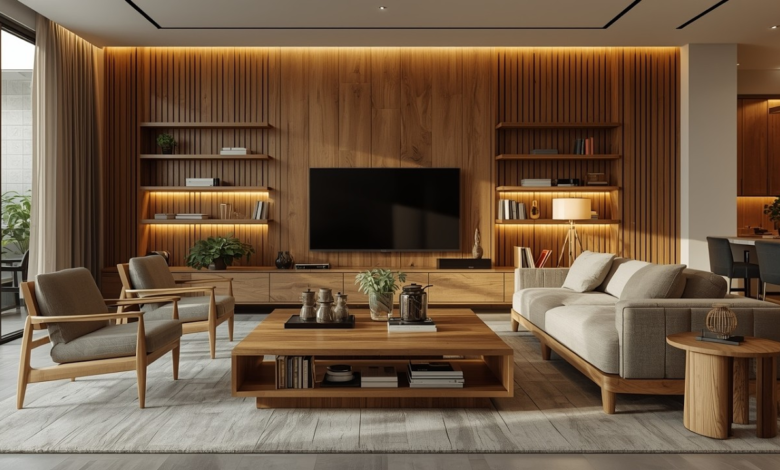
Modern furniture design carries a reputation for being cold — all glass, steel, and hard edges. But some of the strongest work in contemporary interiors right now is coming from a different direction entirely: modern design built in timber. Clean lines and minimal forms don’t require synthetic materials to achieve; they’re just as achievable, arguably more warmly, in solid wood.
The confusion partly comes from how “modern” gets used loosely to describe anything recent, when it actually refers to a specific design language — simplicity, function-first forms, minimal ornamentation, and an emphasis on proportion over decoration. Timber furniture fits that language naturally. A well-proportioned console table in mango wood or Tasmanian oak, built with clean joinery and no unnecessary detailing, is every bit as “modern” as a chrome-and-glass equivalent — it just brings warmth and texture that purely synthetic pieces can’t replicate.
A Short History of the Style
It’s worth understanding where this idea actually comes from, because it isn’t a recent trend. Mid-century designers of the 1950s and 60s — the era most people picture when they hear “modern furniture” — worked extensively in timber. Danish and Scandinavian designers in particular built entire design movements around solid wood: tapered legs, exposed joinery treated as a design feature rather than something to hide, and a general philosophy that a piece of furniture should look exactly as functional as it is, with no applied ornament pretending otherwise. That aesthetic never really went away; it’s simply cycled back into fashion roughly every fifteen to twenty years, and it’s back in a significant way right now, driven partly by a broader shift away from disposable, mass-produced furniture and back toward pieces designed to last.
What’s changed since the mid-century period is manufacturing precision. Modern joinery techniques and finishing processes mean today’s timber furniture can achieve tighter tolerances and more consistent finishes than what was possible seventy years ago, without losing the handmade warmth that made the original style appealing in the first place.
See also: Home Improvement Tips for a Stress-Free Renovation
Why Timber Suits Contemporary Interiors
Part of the shift toward modern wood furniture comes down to how interiors are actually being lived in. Open-plan homes with lighter colour palettes benefit from natural material contrast — a room full of white walls, neutral upholstery, and painted cabinetry needs something with texture and grain to stop it feeling flat. Timber does that job better than most alternatives, because the material itself carries visual interest without requiring bold colour or pattern. A single well-chosen timber piece — a console table, a media unit, a set of open shelving — can anchor an entire room’s palette without a single extra design decision.
There’s also a practical dimension. Modern furniture design tends to favour multi-functional, space-efficient pieces — modular sofas, storage-integrated coffee tables, TV units with concealed cable management. Timber construction handles these functional demands well, because solid wood holds hardware, hinges, and drawer runners more reliably over time than composite boards, which can strip out or sag under repeated use. A drawer runner screwed into solid timber stays tight for years; the same runner screwed into particleboard can work loose within a couple of seasons of regular use.
Sustainability has become part of the modern design conversation too, and here timber has a genuine advantage over synthetic and composite materials. Furniture built from responsibly sourced hardwood, designed to last decades rather than years, sits more comfortably with the values a lot of buyers now bring to furnishing a home than mass-produced composite pieces built around a shorter replacement cycle. Timber is also, at end of life, a far more manageable material than composite boards bonded with synthetic resins — it can be repurposed, refinished, or eventually recycled in ways particleboard generally can’t.
Reading a Room for Timber
Not every space suits the same approach to timber furniture, and one of the more common styling mistakes is treating “modern wood furniture” as a single look rather than a spectrum. A small apartment living room generally benefits from lighter timber tones — blonde oak, ash, or lightly finished mango wood — paired with slim, tapered legs that keep pieces visually light and stop the room feeling boxed in. Larger living rooms with higher ceilings can carry darker, heavier timber tones and chunkier proportions without the same risk of feeling cramped.
Colour palette matters as much as the timber itself. Warm timber tones pair naturally with earthy, muted colour schemes — olive, rust, warm greys — while cooler, more contemporary interiors with blacks, whites, and steel accents tend to suit lighter or more neutral timber finishes so the wood reads as a design choice rather than clashing with the room’s temperature. Getting this pairing wrong is one of the most common reasons a genuinely well-made timber piece can end up looking out of place in an otherwise considered room.
Choosing Well-Designed Timber Pieces
Not every timber piece marketed as “modern” delivers on the promise. It’s worth looking for a few specific things: clean, unfussy lines rather than heavy ornamentation; consistent proportions between a piece and the room it’s meant for; and joinery and finish quality that will actually hold up, since a genuinely modern design loses its appeal fast if it doesn’t age well. Hardware — handles, hinges, runners — is also worth checking, since even a well-designed timber frame can be let down by cheap fittings that fail well before the timber itself shows any wear.
Species selection plays a bigger role than most buyers realise. Mango wood has become popular for modern furniture partly because it takes a clean, contemporary finish well and has a fast growth cycle that makes it a more sustainable choice than slower-growing hardwoods. Tasmanian oak and blackwood offer more traditional grain patterns and tend to suit slightly more classic interpretations of the modern style. None of these are objectively “better” — the right choice depends on the finish, tone, and grain character a room calls for.
It’s also worth paying attention to how a piece is actually built, not just how it looks in a product photo. Genuine mortise and tenon or dovetail joinery, rather than screws and glue alone, is a strong indicator that a piece was designed to last rather than simply to look good in a showroom. Buyers who ask these questions before purchasing tend to end up with furniture that still looks and functions well a decade later, rather than pieces that need replacing once the finish wears or joints start to loosen.
Caring for Modern Timber Furniture
One advantage of well-made timber furniture is how straightforward it is to maintain. Regular dusting and an occasional wipe with a slightly damp cloth handles most day-to-day care. For pieces with an oiled finish, an annual reapplication of furniture oil keeps the timber protected and the colour rich rather than allowing it to dull over time. Direct, sustained sunlight is worth avoiding where possible, since UV exposure can gradually lighten timber tones unevenly — though this is a slow process and easily managed by rotating rugs or repositioning furniture occasionally in rooms with strong natural light.
Minor surface marks are rarely a serious problem with solid timber the way they would be with a veneer or laminate finish. A light scratch or water ring can usually be buffed out or spot-treated without needing to refinish the entire piece, which is one of the quieter practical advantages of buying solid wood over composite alternatives.
Bringing It Together
For anyone updating a living room and wanting the warmth of timber without sacrificing a contemporary look, it’s worth browsing a proper modern wood furniture collection rather than assuming “modern” and “timber” sit at opposite ends of the design spectrum. The two pair well when the design is done properly — clean forms, quality timber, considered proportions, and construction built to last, rather than furniture that only reads as modern until the finish wears through.
That combination — contemporary design language executed in a material that ages well rather than degrading — is increasingly what buyers are actually looking for, and it’s a large part of why timber has found its way back into modern interior design rather than staying confined to more traditional, heavier styles. Furniture that looks considered on day one and still looks considered a decade later is, in the end, the whole point of buying well rather than buying often.
Comparing Common Timber Species
Buyers new to solid wood furniture often assume “timber” is a single category, when in practice the species used changes the look, weight, and price of a piece significantly. Mango wood has become one of the more popular choices for modern furniture over the last decade, largely because it’s fast-growing — making it a comparatively sustainable hardwood — and because it takes contemporary finishes cleanly, with a grain pattern that reads as understated rather than busy. It’s a good fit for buyers wanting a modern look without the higher price tag that slower-growing species command.
Tasmanian oak sits at the more traditional end of the modern spectrum. It has a straighter, more consistent grain than mango wood and takes both light and dark finishes well, which makes it a flexible choice for rooms that might be restyled over time without needing to replace the furniture itself. It’s also notably strong for its weight, which is part of why it shows up so often in dining and living room furniture that needs to handle daily use.
Blackwood is the heavier, more premium option of the three. Its grain is richer and more pronounced, and it darkens further with age and light exposure, which some buyers specifically seek out for statement pieces. It costs more than mango wood or oak, but for a single anchor piece — a media unit or a large console table — the extra investment often pays off in how much character the piece brings to a room.
None of these species is a wrong choice; the right one depends on budget, the room’s existing palette, and whether the goal is a quiet, blend-in piece or a statement item that draws the eye.
Common Questions About Modern Timber Furniture
A few questions come up repeatedly from buyers considering the switch from composite to solid wood. One is whether solid timber furniture is noticeably heavier and harder to move — the answer is generally yes, timber pieces do weigh more than composite equivalents, but this is often treated as a feature rather than a downside, since it also means the furniture sits solidly in place rather than shifting or wobbling with use. Another common question is whether solid wood furniture requires professional maintenance — it doesn’t, in most cases; the oiling and dusting routine described earlier is well within reach for most households and doesn’t require specialist products or services.
Buyers also frequently ask whether flat-pack or ready-to-use is more common for solid timber pieces. Both exist, but many well-made timber pieces, particularly larger items like media units and console tables, are supplied pre-assembled specifically because the joinery is part of what gives the piece its strength — flat-pack assembly using standard fittings can’t always replicate the same structural integrity as joinery completed by the maker.