Manufacturers of such parts always have to make sure that the parts are reliable while minimizing the use of material, production time, and the cost of operation. The choice of the manufacturing process may influence these factors. Sintering of metals may be considered as one possible solution.
When trying to estimate the process, manufacturers should pay attention to how the process works. This process may help to create complicated shapes of parts, efficient use of materials, reliable production, and some special performance requirements. It would be helpful to understand more about each step of the process.
1. Understanding Sintered Metal Solutions
Sintered Metal Solutions makes use of powder metallurgy techniques for turning metal powders into the final component. In this technique, rather than working with a chunk of metal and subtracting from it, the process is used to create a component out of compacted and then heated metal powders.
Any material can be used in the process, such as iron, steel, bronze, metal alloys, and other types of materials. The choice of material is determined by the properties of the resulting product, which may include strength, hardness, durability, size, and many other features.
Being powdered metal, it is easier to control the composition and shape of the material. The possibility arises of producing parts requiring several machining operations.
See also: How Technology Is Transforming the Home Buying Experience
2. How the Sintering Process Works
The procedure starts with blending. Metal powders are combined with alloying agents along with appropriate lubricants to prepare a homogeneous powder mixture. It is crucial to blend the components homogeneously, as it helps maintain the consistency of the material properties in the course of manufacturing.
Then, the mixture is subjected to the compacting process. A specified amount of material is packed inside a die and compressed to create a fragile part, which is called a green compact. This component has the required shape but does not have sufficient mechanical properties yet.
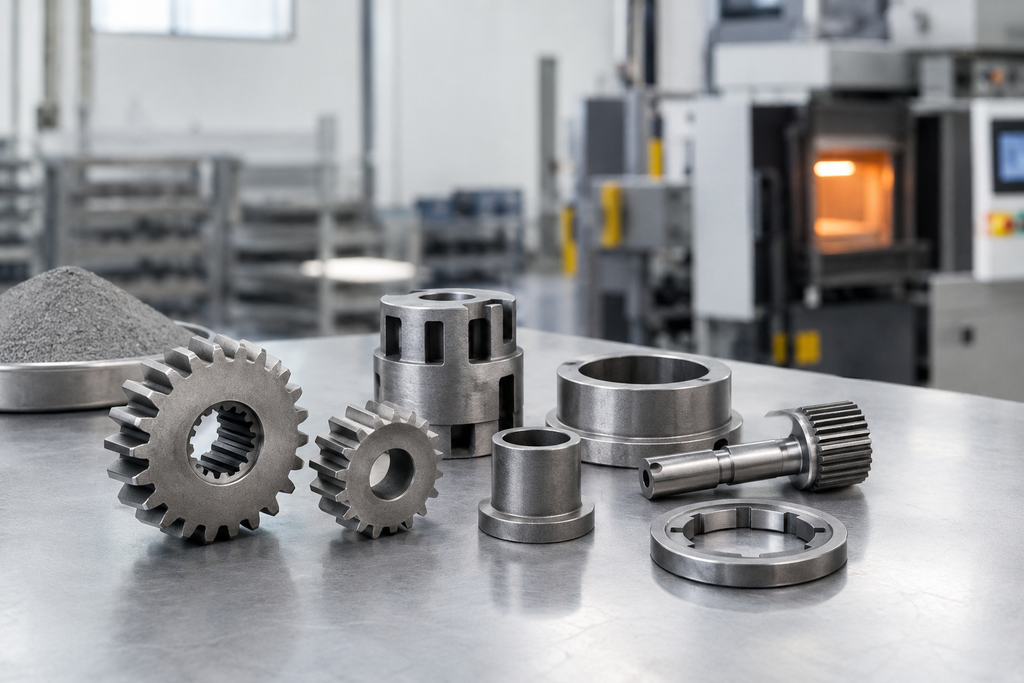
Following that, sintering takes place. The compact is heated in a specially prepared furnace below the metal melting point, usually within the temperature range of 1100°C to 1350°C. As a result of thermal processing, atoms diffuse across the particles, forming bonds.
The component cools down in a controlled manner. Controlled cooling prevents the oxidation process and helps keep the properties of the material stable. After that, depending on the requirements, various post-processing procedures such as sizing, oil impregnation, machining, or heat treatment are performed.
3. Efficient Material Use and Near-Net-Shape Production
One of the many benefits of powder metallurgy lies in the effective use of materials. This is because components manufactured through this process can be designed close to their final size, thus reducing machining operations.
This near-net-shape capability can lower scrap and make better use of purchased raw materials. For manufacturers producing large quantities, even modest reductions in material waste can have a meaningful effect on production costs.
The reduced need for extensive machining can also shorten manufacturing cycles. Fewer secondary operations mean less cutting, finishing, and tool usage. This makes the process particularly attractive when production volume is high, and consistency is important.
4. Producing Complex Component Geometries
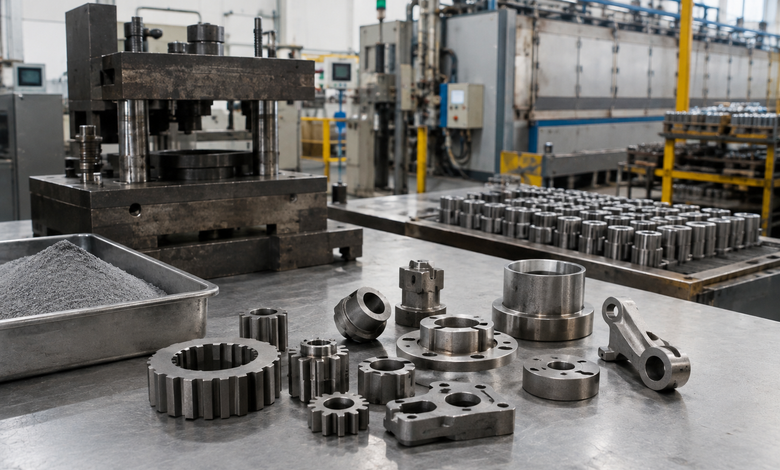
Design flexibility is another important part of the manufacturing value offered by sintered metal. Powder compaction can create features such as gear teeth, splines, cams, slots, and certain internal or non-circular openings as part of the forming process.
Producing these features through conventional machining can require multiple tools and operations. Forming them directly during compaction can simplify production and reduce the amount of secondary work required.
This capability also allows component designs to be developed around specific functional requirements. When a complex feature can be incorporated into the compaction stage, manufacturers can achieve useful geometry without adding unnecessary production steps.
5. Key Performance Benefits for Manufacturers
This procedure can be modified in order to provide special mechanical properties. The use of special materials and sintering conditions can provide strength, hardness, fatigue, and wear resistance for components that will operate under difficult conditions in industry.
Sinter-hardening is one of the advanced methods that can enhance hardness and mechanical properties. These features are important for components that experience loading, friction, and constant movement.
Another advantage is controlled porosity. The internal pore structure of a component can be adjusted for particular functions. Porous materials can support industrial filtration, while oil-impregnated porous bushings can retain lubricant and release it during operation. This makes engineered sintered metal components useful when a component needs more than simple structural strength.
6. Cost Advantages in High-Volume Production
Sintered metal is especially economical when the production of huge numbers of uniform pieces is necessary for a company. After the proper tooling is made, automatic compaction can create uniform parts at a fast pace.
Material efficiency contributes to the savings by reducing scrap, while near-net-shape production can limit machining requirements. The combination can reduce labor, tooling, and processing demands compared with manufacturing routes that depend heavily on material removal.
The economic benefit becomes more significant as production volumes increase. For suitable component designs, the ability to repeat the same process across large batches can provide a stable and efficient manufacturing route.
7. Consistency and Process Control
In addition, manufacturers require consistency between components. In order to sinter metal, controlled levels of powder composition, die design, pressure, furnace environment, and cooling must be achieved. Control of these factors ensures consistent sizing and physical properties during manufacturing.
This repeatability can reduce variation and support reliable assembly when components are produced in high quantities.
Secondary operations can also be used when tighter dimensions or specific surface characteristics are required. This provides manufacturers with a balance between efficient primary forming and targeted finishing.
8. Making the Right Manufacturing Choice
Sintered metal is most valuable when its process advantages align with the requirements of the component. High production volumes, complex geometries, material efficiency, controlled porosity, and repeatable dimensions are all factors that can make the process a strong option.
Compared with machining from solid stock, powder metallurgy can reduce material removal and simplify the production of certain complex shapes. It provides more control in terms of dimensions, density, and porosity compared to conventional casting.
Therefore, the appropriate method of manufacturing should be selected based on the design and materials specifications of the part, along with the production quantity and performance specifications.
Turning Process Advantages Into Manufacturing Value
The true potential of sintered metal for manufacturers lies in how all of these properties complement each other. Proper use of materials may help in reducing waste, near-net-shape manufacturing will cut down on machining needs, while proper processing will ensure performance.
Volunteer Sintered Products provides a focused approach to powder metal manufacturing for applications where these characteristics matter. Compared with conventional machining suppliers or traditional casting manufacturers, a specialized sintered metal manufacturer can better align powder selection, compaction, sintering, and finishing with the requirements of powder metallurgy.
Understanding the complete process makes it easier to evaluate where sintered metal can provide the greatest manufacturing value. When the design and production requirements match its capabilities, it can offer an efficient path to consistent, functional, and cost-effective metal components.