
Core Principles of Digital Marketing for Niche Industries
In today’s crowded digital landscape, generic marketing campaigns often fall flat. For businesses operating in specialized, niche industries, a one-size-fits-all approach simply doesn’t work. We understand that your audience isn’t just looking for a product or service; they’re seeking a precise solution to a unique problem.
Successfully reaching these highly specific markets demands a deep understanding of their unique needs, language, and buying behaviors. Trying to apply broad strategies wastes resources and misses valuable opportunities. Instead, specialized digital marketing can deliver significantly higher engagement, better lead quality, and stronger client relationships.
This comprehensive guide will explore the core principles and high-impact strategies necessary for effective digital marketing in niche industries. We will delve into how to connect with distinct audiences, navigate complex regulatory environments, and measure what truly matters for long-term growth. From technical SEO to understanding multi-stakeholder buying committees, we’ll uncover the tailored approaches that drive success. Especially in complex fields like industrial manufacturing or specialized B2B software, or even marketing for hard tech, a deep understanding of the buyer’s journey is essential. Join us as we unlock the power of specialization.
Digital marketing for niche industries operates on a fundamentally different premise than mass-market campaigns. Our approach is built on precision, not volume. We focus on identifying and engaging a highly specific audience with tailored messages that resonate deeply with their unique challenges and aspirations. This requires a meticulous understanding of several core principles:
- Strong Market Demand: Even within a niche, there must be a clear, identifiable need for your product or service. Our research begins with understanding the specific pain points your target audience faces, ensuring there’s a genuine appetite for a solution.
- High-Value Conversions: Niche markets often involve higher-ticket items, longer sales cycles, or critical services. Consequently, the focus shifts from sheer lead quantity to lead quality. We prioritize strategies that attract prospects with a high propensity to convert, leading to a stronger return on investment (ROI).
- Regulatory Compliance: Many niche industries, such as healthcare, legal, finance, and certain B2B sectors, operate under strict regulatory frameworks. Our strategies are designed from the ground up to ensure full compliance, mitigating risks and building trust with discerning audiences.
- Specification Search: Technical buyers, engineers, and specialized professionals don’t search like consumers. They often use highly specific terminology, part numbers, and detailed specifications. Our marketing must meet them at this precise point of need, providing the exact information they require to make informed decisions.
- Multi-Stakeholder Committees: In B2B niche environments, purchasing decisions are rarely made by a single individual. Instead, they involve complex buying committees with diverse roles and priorities. Our digital marketing efforts must address the concerns of each stakeholder, from technical specifiers to financial approvers.
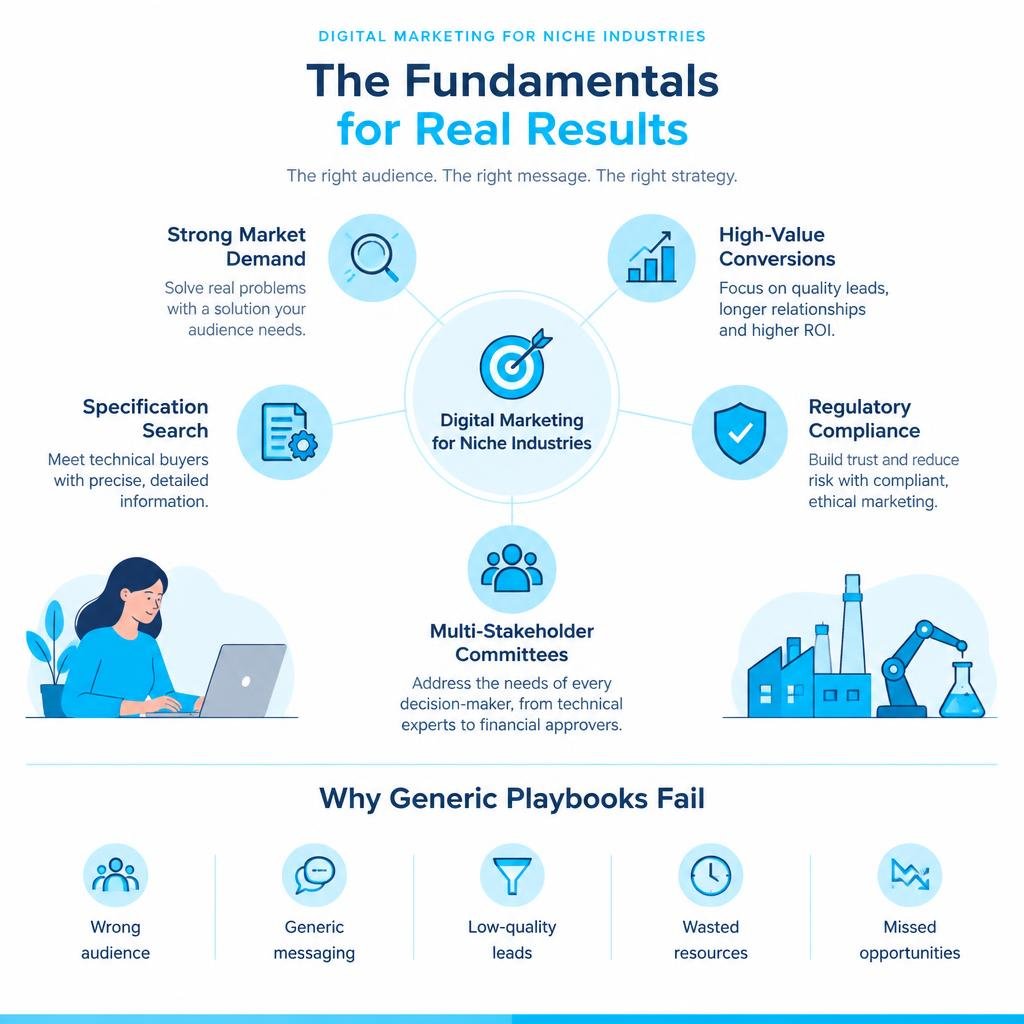
These principles form the bedrock of our strategy, allowing us to craft campaigns that are not only effective but also highly efficient, delivering measurable results for specialized businesses.
Why Generic Playbooks Fail in Digital Marketing for Niche Industries
The digital marketing landscape is flooded with “one-size-fits-all” advice, but for niche industries, adopting generic playbooks is a recipe for inefficiency and frustration. We’ve consistently observed that such approaches fall short due to several critical factors:
- Broad Targeting and Wasted Spend: Generic campaigns often target overly broad demographics, leading to significant ad spend on audiences with little to no interest in specialized offerings. This results in low engagement, poor lead quality, and a diluted marketing budget.
- Conversion Leakage: When messaging isn’t tailored, it fails to resonate. Prospects arriving at generic landing pages or encountering irrelevant content quickly disengage, leading to high bounce rates and lost conversion opportunities. There’s a fundamental mismatch between the unique problem a niche audience has and the generalized solution being presented.
- Generic Copy and Lack of Authority: Niche audiences, especially professionals, are adept at spotting generic, buzzword-laden copy. They seek expertise and a deep understanding of their specific industry challenges. Generic messaging signals a lack of specialization, eroding trust and perceived authority.
- Compliance Risks: Applying general marketing tactics to regulated industries can lead to severe compliance breaches. Forgetting industry-specific disclaimers, data privacy regulations, or advertising restrictions can result in hefty fines and reputational damage.
- Buyer Skepticism: Specialized buyers are inherently skeptical of generalist providers. They want to work with experts who speak their language and understand their unique operational context. A generic marketing presence fails to convey this crucial expertise, making it difficult to build the necessary credibility.
Generalist strategies are more expensive in the long run. Our data shows that niche-focused agencies command 20-50% higher rates and experience stronger client retention than generalist competitors, precisely because they deliver superior, more targeted results by avoiding these common pitfalls.
Aligning Multi-Role Buying Committees and Long Sales Cycles
One of the defining characteristics of digital marketing for many niche industries, particularly in B2B and hard-tech sectors, is the presence of multi-role buying committees and extended sales cycles. Unlike simple consumer purchases, these decisions involve multiple stakeholders, each with their own priorities and concerns. Our strategies are meticulously designed to address this complexity:
- Technical Specifiers: These are often engineers, R&D teams, or operational managers who need to ensure the product or service meets precise technical requirements. Our content for this group includes detailed datasheets, specifications, application notes, CAD/BIM files, and performance benchmarks. They are looking for solutions to specific technical problems.
- Procurement Officers: Focused on cost-effectiveness, vendor reliability, contract terms, and supply chain efficiency. Our messaging for procurement emphasizes total cost of ownership (TCO), long-term value, and seamless integration into existing systems.
- Financial Approvers: Concerned with budget, ROI, and financial risk. Content for this audience highlights cost savings, efficiency gains, and the measurable financial impact of the solution. Case studies with clear ROI figures are crucial here.
- Compliance Directors: In regulated industries, these stakeholders ensure that any new solution adheres to relevant industry standards, certifications (e.g., ISO 13485, FDA 510(k)), and legal requirements. We create dedicated content hubs for regulatory information, certifications, and compliance roadmaps to build trust and mitigate risk.
- Consensus Building: The ultimate goal is to provide each member of the committee with the information they need to say “yes.” This means creating a cohesive content journey that guides each stakeholder through their specific decision-making process, ultimately leading to a unified consensus. For example, in the dental equipment sector, a single purchase can involve a clinician, practice manager, financial decision-maker, and even a compliance officer. Each requires distinct information to move forward.
By understanding and addressing the unique needs of each role within the buying committee, we can significantly shorten sales cycles and increase conversion rates, even for complex, high-value solutions.
High-Impact Vertical Strategies: Industrial, B2B Tech, and Regulated Markets
Successfully navigating the digital landscape in specialized sectors demands more than just general marketing tactics; it requires high-impact vertical strategies. We recognize that the buyer’s journey, regulatory environment, and competitive landscape differ dramatically across industries. Our approach is to tailor every aspect of our digital marketing efforts to these unique vertical nuances, ensuring maximum relevance and effectiveness.
This section delves into specific strategies that drive results in industrial, B2B tech, and highly regulated markets, illustrating how specialization translates into tangible business growth.
Technical SEO and Content Architectures in Digital Marketing for Niche Industries
For industrial manufacturers, B2B tech companies, and other hard-tech sectors, traditional SEO often falls short. Their buyers aren’t searching for generic terms; they’re looking for highly specific solutions, components, and technical data. Our strategy for these verticals centers on a robust technical SEO and content architecture designed to capture this precise intent:
- Datasheet Indexing and Rich Snippets: We ensure that critical technical data, traditionally buried in PDFs, is converted into structured HTML content. This allows search engines to properly index specifications, features, and compatibility information, making it discoverable for engineers and technical buyers. Implementing Product and MedicalDevice schema markup further enhances visibility, allowing this data to appear as rich snippets in search results.
- CAD/BIM Integration and Gated Content Strategy: Engineers often need to download CAD (Computer-Aided Design) or BIM (Building Information Modeling) files to integrate components into their designs. We advocate for publishing these files openly, as engineers often avoid suppliers who gate basic technical data. This dramatically increases specification wins. Gating should be reserved for high-value assets like comprehensive whitepapers or custom configuration tools.
- Search Intent Mapping for Long-Tail Queries: Technical buyers use long-tail keywords that are incredibly specific (e.g., “stainless steel pressure sensor 0-10V output IP67”). Our content strategy maps to these granular queries, creating dedicated pages, application notes, and sizing guides that directly answer these precise needs.
- Regulatory-Driven Content Hubs: For industries with stringent compliance requirements, we build authoritative content hubs around relevant standards (e.g., ISO 13485, FDA 510(k), CE MDR). These hubs not only build trust and credibility but also serve as powerful SEO assets, capturing search traffic from compliance officers and quality assurance teams.
- Cross-Reference and Interchange Content: Many industrial buyers are looking to replace existing parts or find compatible alternatives. Creating cross-reference tables that map competitor part numbers to your own products captures high-intent replacement demand, a strategy that has proven to boost conversions multiple times over generic category pages.
By focusing on these specialized tactics, we transform product data into a powerful marketing asset, ensuring that when a technical buyer searches for a solution, your business is the authoritative answer. This deep dive into technical content and SEO is precisely what differentiates effective marketing for hard tech from generic B2B approaches.
High-Intent Search and Reputation for Professional Practice Verticals
For professional services like legal, healthcare, and financial advisory, digital marketing hinges on establishing trust, demonstrating expertise, and capturing high-intent local searches. These are often high-stakes decisions for clients, making reputation and authority paramount. Our strategies focus on:
- Local Pack Dominance: For local service providers, appearing in Google’s local pack is critical. This requires meticulous Google Business Profile optimization, consistent NAP (Name, Address, Phone) citations, and a proactive review management strategy. Our goal is to ensure your practice is easily found by local clients actively seeking services.
- Review Recency and Velocity: While the total number of reviews matters (97% of consumers read reviews for local businesses, and 47% won’t use a business with fewer than 20 reviews), recency is even more crucial. As of September 2026, 74% of consumers only care about reviews written in the last three months. We implement automated systems to encourage a steady drip of new, positive reviews, ensuring your online reputation remains fresh and compelling. A dental practice, for instance, saw a 30% lift in local pack rankings by setting a 20-review floor and maintaining review velocity.
- High-Stakes Conversion Optimization: When clients are searching for a lawyer, doctor, or financial advisor, they are often facing significant life events. Our website design and messaging are crafted to convey empathy, professionalism, and a clear path to resolution. Calls to action are designed to facilitate trust-building first, such as “Request a Consultation” or “Download Our Guide,” rather than immediate purchase.
- Practice Area Authority through Deep Content: To establish authority, we develop comprehensive content that addresses specific client concerns within your niche. For a law firm, this means creating in-depth articles on specific types of personal injury, family law, or corporate litigation. For a healthcare provider, it could involve detailed guides on specific conditions or treatments. This deep content not only answers client questions but also signals expertise to search engines.
- Leveraging Patient/Client Search Behavior: We know that 89% of patients Google their health symptoms before visiting their doctor. This presents a massive opportunity for healthcare providers to capture early-stage search intent with informative, SEO-optimized content. Similarly, legal clients often research specific legal issues before contacting an attorney. Our strategies aim to be the authoritative resource at these critical junctures.
By combining strong local SEO with a focus on reputation management and expert content, we help professional practices build trust and convert high-intent prospects. For specialized guidance on navigating the complexities of legal marketing, resources like those focused on SEO for law firms can provide invaluable insights into this highly competitive vertical.
Specialized E-Commerce and Manufacturing Catalog Optimization
Niche e-commerce and manufacturing with extensive product catalogs present unique digital marketing challenges that go far beyond standard online retail. These businesses often deal with complex products, custom configurations, and B2B purchasing processes. Our strategies are designed to optimize these specialized online experiences:
- Custom Quoting and Configuration Tools: For products that require customization or complex pricing (e.g., industrial machinery, specialized components, or custom-built items like cabinets), a simple “add to cart” button is insufficient. We integrate sophisticated online configurators and custom quoting systems that allow buyers to specify their needs, receive instant pricing, and streamline the sales process. This is crucial for industries where every order is unique.
- Digital Catalogs with Advanced Filtering: Manufacturers with thousands of SKUs need more than just a product listing. We build highly organized digital catalogs with advanced filtering, faceted navigation, and robust search functionalities. This allows technical buyers to quickly find the exact part, component, or product they need based on specifications, certifications, or applications.
- Visual Configurators and 3D Models: For highly visual products or those with many customizable options, visual configurators and interactive 3D models are game-changers. These tools enhance the user experience, reduce buyer uncertainty, and can significantly increase conversion rates by allowing customers to visualize their customized product before purchase. For example, a digital platform for cabinets would greatly benefit from such tools, allowing customers to design and visualize their kitchen layouts.
- Supply Chain and Inventory Integration: For B2B e-commerce, seamless integration with inventory management and supply chain systems is paramount. This ensures real-time stock availability, accurate lead times, and efficient order fulfillment, all of which are critical factors for business buyers.
- SEO for Product Variants and Technical Specifications: Optimizing product pages for specific part numbers, model variants, and technical specifications is key. This includes using schema markup for product data, creating unique content for each variant, and ensuring that product descriptions are rich with relevant keywords that technical buyers use.
By implementing these specialized e-commerce and catalog optimization strategies, we help niche businesses transform their online presence into a powerful sales and specification tool, driving both efficiency and revenue.
Channel Selection and Execution Frameworks by Industry Type
Choosing the right digital marketing channels is not a one-size-fits-all decision, especially in niche industries. The optimal channel mix depends heavily on the specific vertical, buyer intent, regulatory environment, and sales cycle length. Our approach involves a strategic framework for channel selection, ensuring that every marketing dollar is invested where it will yield the highest impact.
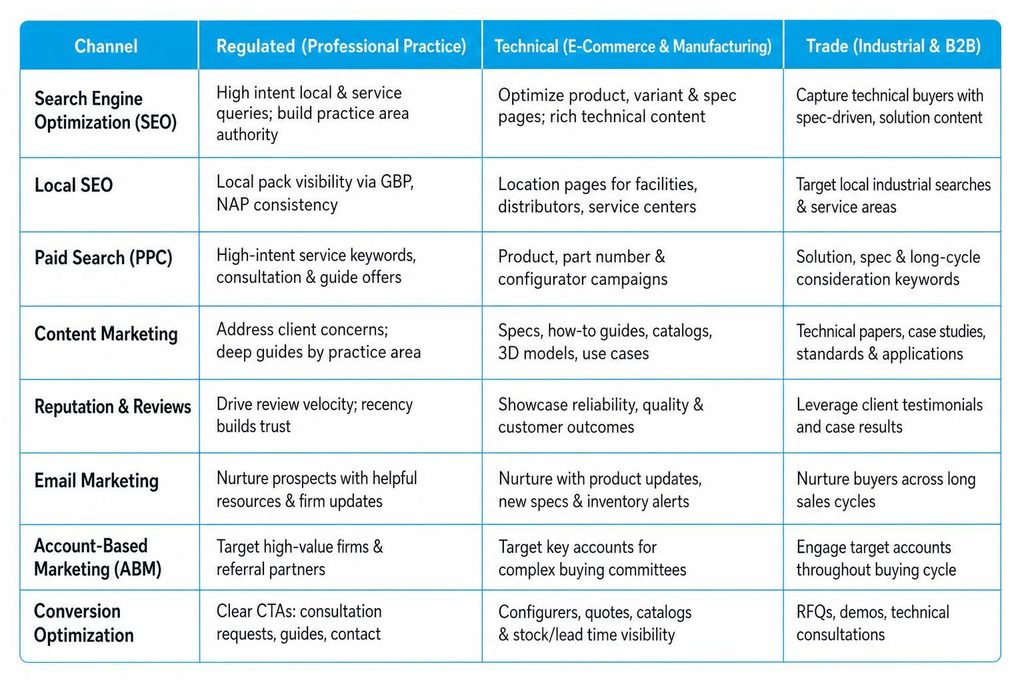
This framework helps us prioritize and integrate channels like industrial SEO, targeted paid search, account-based marketing (ABM), and nurturing email campaigns to create a cohesive and effective strategy for each unique industry.
Search Engine Visibility and Generative Search Optimization (GEO)
The evolution of search engines, particularly with the rise of AI-powered generative search experiences, means that simply ranking high is no longer enough. We now focus on Generative Search Optimization (GEO) to ensure our clients’ content is not only found but also cited as an authoritative answer by AI Overviews and large language models (LLMs). This is a critical shift, especially for niche and technical industries:
- Adapting to AI Overviews: AI Overviews, which appear on 20.5% of all SERPs as of September 2026, are changing how users consume information. While they appear on only 7.9% of local queries, they are present on 22.8% of non-local queries and a significant 57.9% of question queries. This means that for educational or research-heavy niche topics, being the source cited by an AI Overview is incredibly valuable. Our strategy involves creating content designed to be easily digestible and summarizable by AI.
- Structured Data for AI Citation: To increase the likelihood of content being cited by LLMs, we implement extensive structured data (Schema.org markup) across websites. This includes Product, FAQ, HowTo, MedicalCondition, and Organization schemas, which provide clear, machine-readable context about the content.
- Technical Glossaries and Definitions: For highly technical niches, we create comprehensive, SEO-optimized technical glossaries. These glossaries define industry-specific terms and concepts in a clear, concise manner, making them ideal candidates for LLM citations when users ask definitional questions.
- LLM Citations and Authority: Our goal is to position our clients as the authoritative source in their niche. This involves producing high-quality, fact-checked content that LLMs can confidently draw upon. The more often your site is cited by AI, the stronger your perceived authority becomes, driving both direct traffic and brand recognition.
- Topical Authority Development: Instead of focusing solely on individual keywords, we build topical authority by creating comprehensive content clusters around core niche subjects. This signals to both traditional search engines and AI models that your site is a deep and reliable resource for a particular domain.
By proactively optimizing for generative search, we ensure our clients maintain strong visibility and become trusted sources of information in an increasingly AI-driven search landscape.
Rapid-Response Lead Handling and CRM Automation
In many niche industries, particularly local services and B2B manufacturing, the speed of lead response can be the ultimate differentiator. Our research indicates that firms that contacted an online lead within an hour were nearly seven times as likely to qualify that lead as firms that waited just one hour longer. This urgency necessitates robust rapid-response lead handling and intelligent CRM automation:
- Sub-Hour Lead Response Times: We work with clients to establish protocols that ensure inbound leads are contacted within minutes, not hours. For emergency services (e.g., HVAC repair, plumbing), this can increase lead qualification by up to 60 times compared to waiting 24 hours. This often involves mobile notifications, dedicated sales queues, and clear accountability.
- Automated Lead Routing: Implementing intelligent CRM (Customer Relationship Management) systems allows for immediate and accurate lead routing. Leads are automatically assigned to the most appropriate sales representative or department based on geographic location, product interest, or lead source, ensuring no valuable inquiry falls through the cracks.
- Pipeline Tracking and Nurturing: Niche B2B sales cycles can be long and complex. Our CRM automation strategies include detailed pipeline tracking, automated follow-up sequences, and personalized nurturing campaigns. This ensures that prospects receive relevant information at each stage of their buying journey, keeping your brand top-of-mind.
- Automated Review Management: For local services and professional practices, maintaining a fresh stream of positive reviews is critical. CRM systems can automate review requests to recent customers, making it easy for them to provide feedback and helping to maintain the crucial recency factor for local SEO.
- Conversion Velocity Optimization: By streamlining the entire lead-to-customer process—from initial inquiry to qualification, nurturing, and conversion—we aim to increase conversion velocity. This not only improves efficiency but also provides a better customer experience, setting the stage for long-term relationships.
Implementing a well-configured CRM with automated workflows is not just about efficiency; it’s about maximizing the value of every lead generated, especially in competitive niche markets.
Measuring Marketing ROI and Long-Term Value in Specialized Sectors
In niche industries, especially B2B and hard-tech, measuring marketing success goes far beyond simple website traffic or click-through rates. We focus on demonstrating tangible return on investment (ROI) and long-term value, aligning our metrics with the business objectives that truly matter to our clients. This requires a sophisticated approach to data analysis and reporting.
Our reporting emphasizes how digital marketing contributes directly to qualified leads, pipeline growth, and ultimately, revenue, ensuring full transparency and accountability.
Key Performance Indicators Beyond Generic Traffic Metrics
While general metrics like website traffic and impressions have their place, they don’t tell the full story for niche businesses. We prioritize Key Performance Indicators (KPIs) that directly reflect business growth and profitability:
- Qualified Inquiries by Application Type: Instead of just “leads,” we track the number of inquiries that meet specific qualification criteria (e.g., budget, authority, need, timeline). For industrial clients, this might mean tracking inquiries for specific product applications or project types. A B2B SaaS firm, for example, saw a 40% lift in inbound demo requests after implementing a keyword-focused blog series.
- Cost Per Qualified Opportunity (CPQO): This metric moves beyond “cost per lead” to measure the efficiency of generating truly viable sales opportunities. It helps us understand the real cost of acquiring a prospect who has a high chance of becoming a customer.
- Lead Qualification Rate: We closely monitor the percentage of raw leads that successfully pass through the qualification process. This helps us refine our targeting and messaging to attract even higher-quality prospects.
- Quoted Value Influenced by Digital Channels: For B2B and industrial sales with long cycles and high-value contracts, we track the total quoted value that originated from or was influenced by digital marketing efforts. This provides a direct link between marketing activities and potential revenue.
- Specification Wins (for Industrial/Hard-Tech): In hard-tech sectors, a “win” can often be when an engineer specifies your component into their design. We track metrics like CAD file downloads or requests for detailed specifications as indicators of early-stage influence.
- Client Lifetime Value (CLTV): For many niche businesses, client retention and repeat business are crucial. We analyze how digital marketing contributes to acquiring clients with higher CLTV, ensuring sustainable long-term growth. A wellness brand, for instance, saw a 30% boost in email-driven revenue within three months after optimizing their email automation.
By focusing on these deeper, more meaningful KPIs, we provide our clients with a clear understanding of the true impact of their digital marketing investments.
Frequently Asked Questions About Niche Digital Marketing
How does marketing for niche industries differ from broad B2B or B2C campaigns?
Marketing for niche industries differs significantly from broad B2B or B2C campaigns in several key ways. Firstly, buyer intent is often much more specific and problem-solution focused. Niche audiences aren’t browsing; they’re actively seeking precise answers to unique challenges. Secondly, there’s a greater technical depth required in messaging and content. You must speak the industry’s specific language and demonstrate deep expertise. Thirdly, sales cycle duration tends to be longer, especially in B2B hard-tech sectors, involving multiple decision-makers and complex evaluation processes. Finally, precise messaging is paramount. Generic claims won’t resonate; every piece of content must be tailored to the specific pain points and aspirations of the narrow target audience. This specialization allows for higher engagement and better conversion rates, as niche expertise can dramatically improve ROI across varied business types.
How long does it take to establish search authority in a specialized vertical?
Establishing search authority in a specialized vertical is a strategic, long-term endeavor that requires consistent effort. For technical fixes (like improving site speed or schema markup), you might see indexation timelines improve within weeks. However, for technical content ranking and building true topical authority, it typically takes 6 to 12 months to see significant results. This is because search engines need time to crawl, index, and understand the depth and relevance of your specialized content. The authority velocity is built through consistent publication of high-quality, expert-level content, earning backlinks from reputable industry sources, and maintaining an optimized technical foundation. Leads generated from this authority often have a lead maturity period, requiring nurturing over several months before conversion, especially in high-value B2B niches. Most agencies report seeing meaningful traction within 6-12 months of focused niche effort.
Why is rapid lead response crucial for niche service and manufacturing providers?
Rapid lead response is absolutely crucial for niche service and manufacturing providers because it directly impacts inbound qualification and conversion rates. Our data shows that firms that contacted an online lead within an hour were nearly seven times as likely to qualify that lead as firms that waited just one hour longer. This speed provides a significant competitive advantage, as many competitors are slower to respond. For emergency services (like HVAC or plumbing), buyer urgency means the first responsive provider often gets the job. Even in B2B manufacturing, a quick, informed response demonstrates professionalism and attentiveness, which can accelerate pipeline velocity and build trust early in the sales process. Implementing automated lead routing and sub-hour response protocols can dramatically improve your chances of converting inquiries into paying customers.
Conclusion
In an increasingly specialized world, the future of digital marketing lies in precision, not broad strokes. For niche industries, abandoning generic playbooks in favor of tailored, expert-driven strategies is not merely an option—it’s a strategic imperative. We’ve explored how a deep understanding of market demand, regulatory compliance, multi-stakeholder buying committees, and the nuances of specialized e-commerce can unlock unparalleled growth.
By focusing on robust technical SEO, adapting to generative search, prioritizing rapid lead response, and measuring truly impactful KPIs, businesses in specialized verticals can build sustainable authority and achieve remarkable ROI. The power of strategic alignment with industry-specific needs, coupled with vertical specialization, leads to sustainable authority that generates high-quality leads and fosters long-term client relationships. This is how we drive long-term growth for those who dare to specialize and truly understand their unique market.